

TRUST BUT VERIFY · ISSUE 002The 8 Questions Every Board Needs for AI.
A one-page executive cheat sheet.
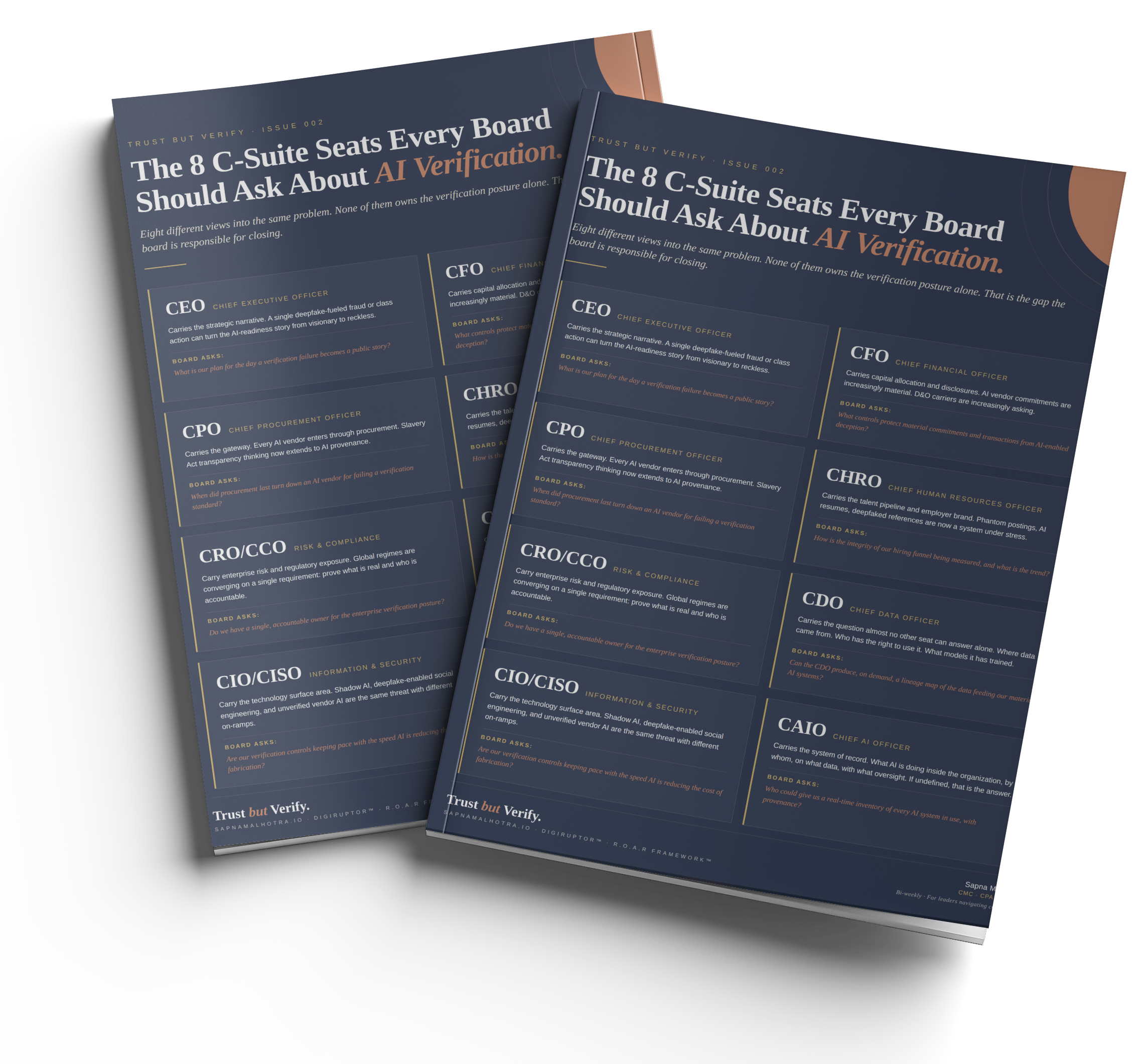
Eight different seats. Eight different views into the same problem. None of them owns the verification posture alone.
This framework provides eight distinct lenses into your organization’s AI readiness. It empowers you to move past the "visionary" story and get to the "verified" truth.
Download the one-pager, drop it into your next board pre-read, and lead with the human advantage.
Why this matters now.
Boards approve AI items in nine minutes. I have watched it happen. Polished deck, known vendor, an audit committee with three procedural questions, then on to lunch.
That is not a governance failure. It is an attention failure. And in the age of generative AI, deepfake fraud, and unverifiable vendor claims, attention failures become balance sheet failures faster than any board cycle is built to absorb.
The KPMG and INSEAD AI Governance Principles for Boards (April 2026) put it plainly: AI is no longer a technology topic to delegate downward. It is a decision quality topic the board owns. The Deloitte State of Generative AI 2026 and the Bloomberg Law analysis of board priorities both confirm what every director already senses: AI risk is now competing with cyber risk and capital allocation for boardroom attention, and most boards do not yet have the seat-by-seat clarity to navigate it.
The 8 C-Suite seats. The 8 board questions.
Eight different seats. Eight different views into the same verification problem. None of them owns the AI verification posture alone. That is the gap the board is responsible for closing.
-
Carries the strategic narrative. A single deepfake fueled fraud or class action can turn the AI readiness story from visionary to reckless.
Board asks: What is our plan for the day a verification failure becomes a public story?
-
Carries capital allocation and disclosures. AI vendor commitments are increasingly material. D&O carriers are increasingly asking.
Board asks: What controls protect material commitments and transactions from AI enabled deception?
-
Carries the gateway. Every AI vendor enters through procurement. Supply chain transparency thinking now extends to AI provenance.
Board asks: When did procurement last turn down an AI vendor for failing a verification standard?
-
Carries the talent pipeline and employer brand. Phantom postings, AI resumes, and deepfaked references are now a system under stress.
Board asks: How is the integrity of our hiring funnel being measured, and what is the trend?
-
Carry enterprise risk and regulatory exposure. Global regimes are converging on a single requirement: prove what is real and who is accountable.
Board asks: Do we have a single, accountable owner for the enterprise verification posture?
-
Carries the question almost no other seat can answer alone. Where data came from. Who has the right to use it. What models it has trained.
Board asks: Can the CDO produce, on demand, a lineage map of the data feeding our material AI systems?
-
Carry the technology surface area. Shadow AI, deepfake enabled social engineering, and unverified vendor AI are the same threat with different on ramps.
Board asks: Are our verification controls keeping pace with the speed AI is reducing the cost of fabrication?
-
Carries the system of record. What AI is doing inside the organization, by whom, on what data, with what oversight. If undefined, that is the answer.
Board asks: Who could give us a real time inventory of every AI system in use, with provenance?
How to use this in your next board meeting.
Drop the one pager into your next pre-read. Run it as a 20 minute board education item. Score each seat from 0 to 2 the way the Connect The Dots digital audit scores individuals: 0 means needs attention, 1 means good enough, 2 means strong and consistent. The seats scoring 0 are the seats the board needs management to address before the next quarter.
This is not a maturity model. It is a board level diagnostic. The point is not to have a perfect score. The point is to know where the gaps are before someone outside the boardroom finds them first.
About Sapna Malhotra
Sapna Malhotra (CMC, CPA, ICD.D) is a board level transformation advisor who helps boards and executive teams build trust in the age of AI. She is the founder of Digiruptor™, creator of the R.O.A.R Framework™, author of Connect The Dots: In the Age of Digital Verification (2nd Edition, 2026), and the writer behind Trust But Verify, a biweekly LinkedIn newsletter for leaders navigating AI, trust, and risk at the board level.
With over two decades of $1B+ technology transformation experience across financial services and telecommunications, an ICD.D designation from the Institute of Corporate Directors, and a Cornell AI Strategy certificate, Sapna sits at the rare intersection of financial discipline, governance fluency, and hands on AI strategy.
She speaks and writes on the cost of professional catfishing, board level AI verification, and the decision quality that separates organizations that govern AI from organizations that get governed by it.
Connect: LinkedIn · Subscribe to Trust But Verify · Subscribe to Probe & Ponder

Related reading.
Trust But Verify, Issue 001: Trust is how work moves. Verification is how it survives AI.
Probe & Ponder: AI handles the ordinary. You handle the extraordinary.
Connect The Dots, 2nd Edition: In the Age of Digital Verification on Amazon
The R.O.A.R Framework™ for decision quality
Upcoming Events
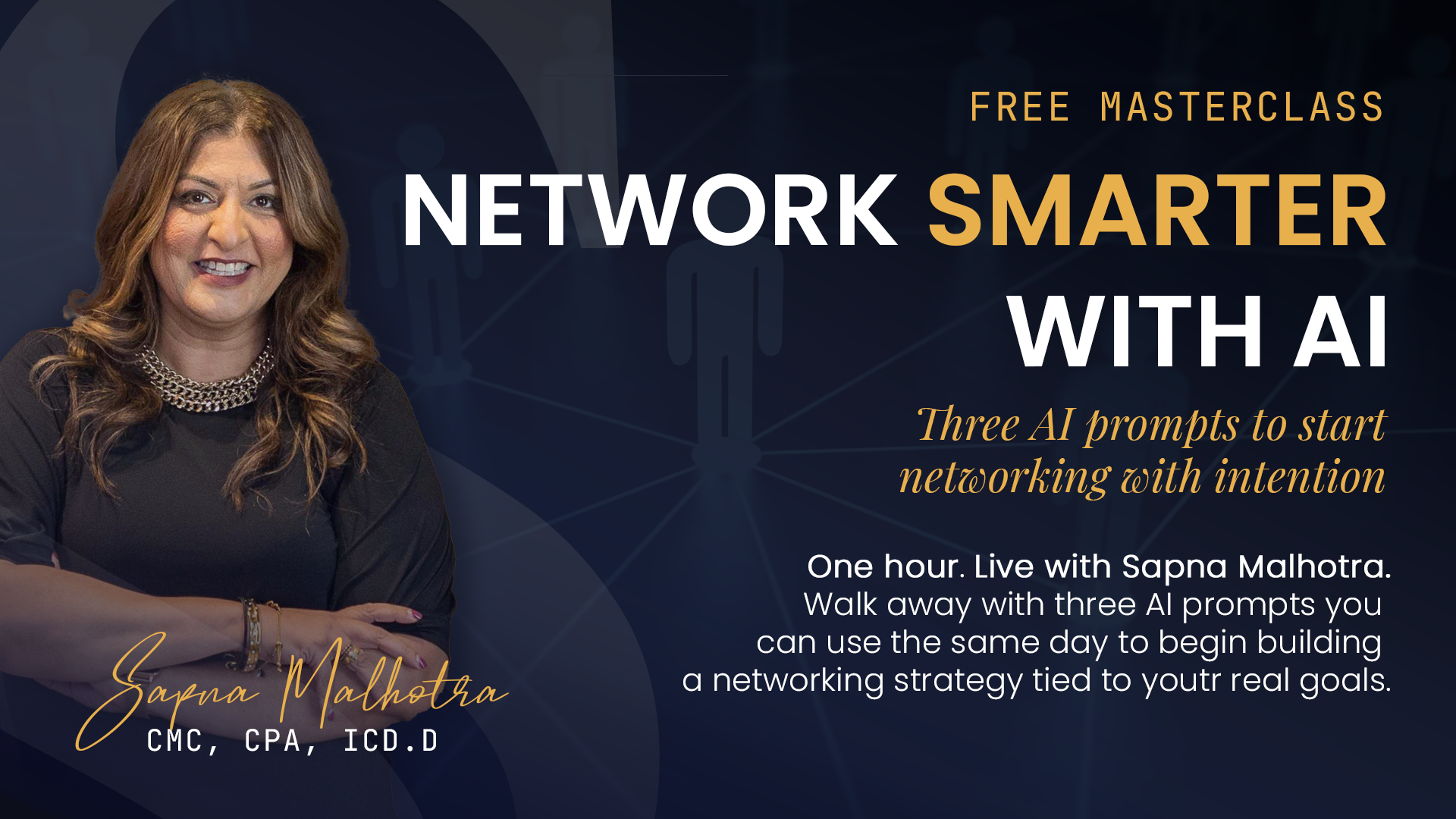
Network Smarter with AI, Free Masterclass.
Most leaders have a network that is a mile wide but an inch deep; it is time to use AI for something genuinely useful. Join Sapna Malhotra live for one hour to see how to scale your intentional networking and move toward your next board seat or career transition with a clear system.
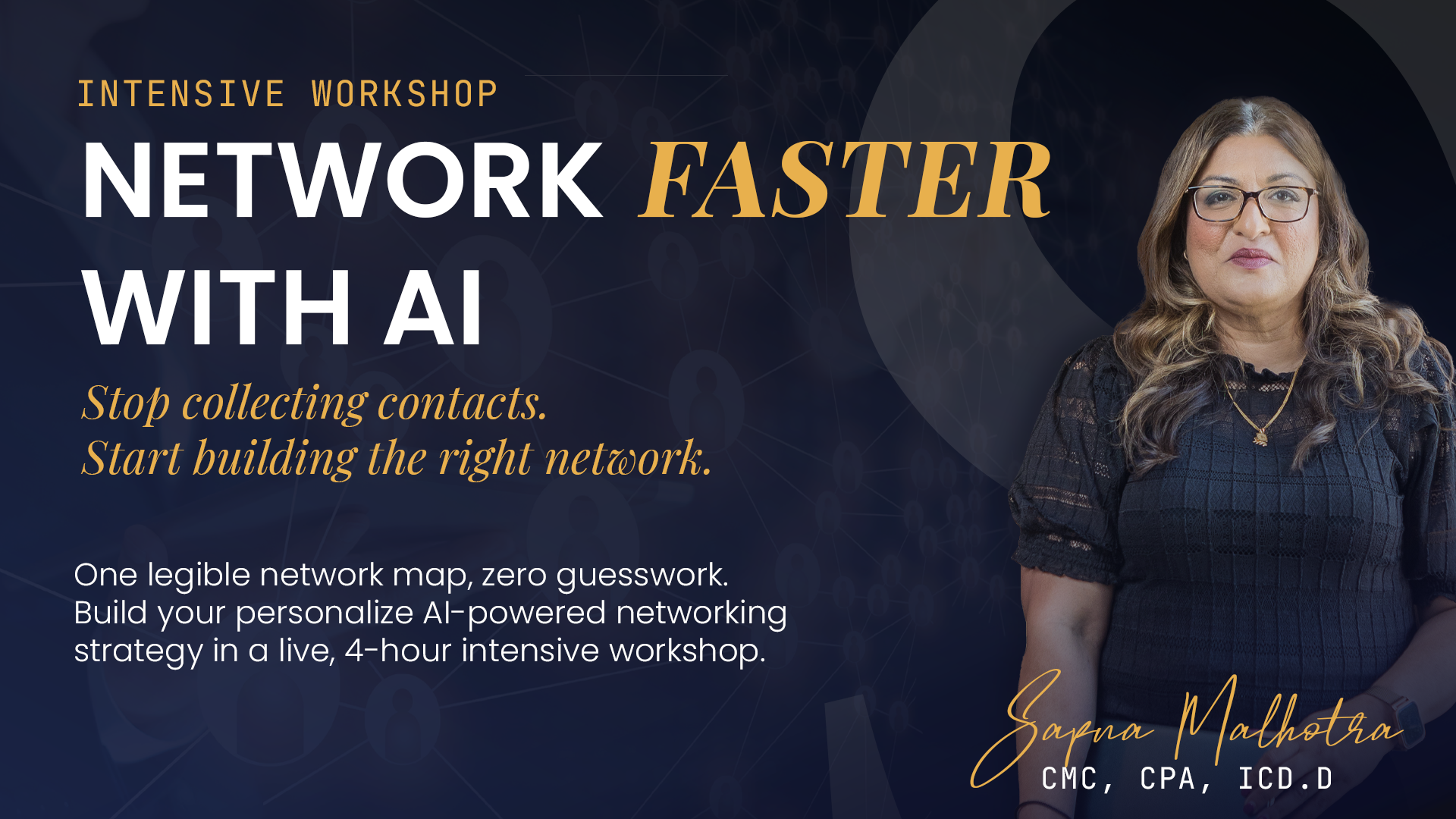
Network Faster. With AI: The Intensive Workshop
Stop collecting contacts and start building a legible network with this 4-hour live intensive. You will use AI to map your actual data into the Three Rings, conduct a 62-point digital audit, and walk away with a quarterly action plan tied to your board or leadership goals.